
Journalist: Jasmine Hornek (ORU)
On average, the state of Oklahoma has around 50–60 tornadoes per year. Considering the number of natural disasters the state faces annually, it becomes a given that people will be trapped beneath rubble. Moreover, mankind has found a simple solution to this problem: dogs.
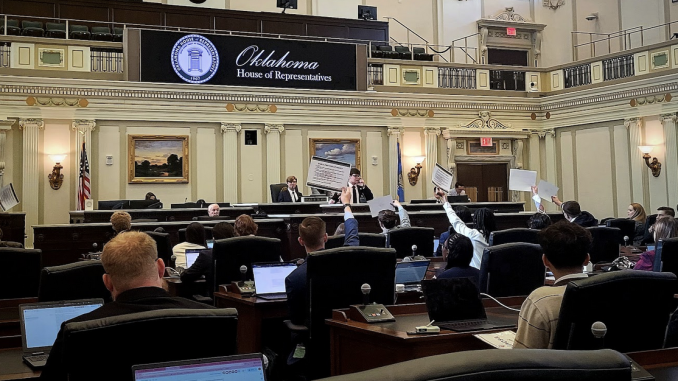
The Canine Cooperative Act was introduced on the floor of the Oklahoma Intercollegiate Legislature today to equip small towns and rural counties that lack trained K-9 units. Proposed by Representative Haynes of the Oklahoma State University delegation, the bill would establish a statewide K-9 Employment Grant Program—a revolving fund designed to help municipalities purchase and train search-and-rescue dogs for disaster response.
Under the proposal, the grant program would operate primarily on private donations, nonprofit support, and federal funds rather than state tax dollars. Grants would be capped at $15,000 for municipalities, with proportional limits for counties and state agencies.
All dogs funded through the program would be trained at a FEMA-certified facility, which the bill’s author noted already exists within Oklahoma. According to Haynes, the measure is meant to strengthen response capacity in a state where tornadoes, missing-person incidents, and historical tragedies like the Oklahoma City bombing underscore the need for rapid search-and-rescue capabilities.
Supporters framed the bill as a low-cost, high-impact investment. Several representatives emphasized the life-saving value of K-9 units during disasters, citing examples ranging from the Oklahoma City bombing to 9/11 recovery efforts.
They argued that rural communities often face delays waiting for distant K-9 responders, and that “time is lives” when victims are trapped under debris. Advocates also emphasized that, because the program is funded through voluntary donations, it avoids imposing new burdens on taxpayers.
Opponents, however, raised concerns about funding inconsistencies and gaps in the bill’s scope. Some pointed to language in Section 3 that permits legislative appropriations, arguing it contradicts the author’s promise of a taxpayer-neutral program. Others questioned the reliability of private donations and federal grants, warning that if outside funding faltered, the financial responsibility might shift to the state.
Despite the concerns, Haynes’s bill survived several procedural motions and moved to a vote. After a lengthy and occasionally heated debate, the Canine Cooperative Act passed the House with a vote of 20–14, sending it forward for further consideration.