
Journalist: Sydni Callaway (OSU)
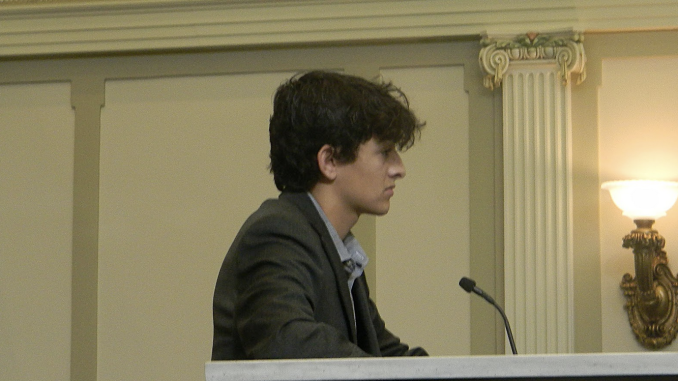
Today, the “Artificial Intelligence Transparency in Academia” Act of 2025, also known as House Bill No. OBU-502, was presented to the House by Rep. Zadyn Joplin (OBU). This bill aims to show that any educational institution must show what AI system is used as well as the extent of human review and oversight. It also mandates that all academic staff and faculty must be provided with proper training on AI. Spiking a lot of questions, this bill was one of the more controversial pieces of legislation heard today.
Speaking with Joplin, he provided insight on what inspired him to create this piece of legislation as well as his thoughts on the entirety of the policy. His purpose of the bill is based on “a personal infringement on rights within education, and being accused of AI usage without proper information to back that up” said Joplin. Alluding to a personal experience, Joplin described how this infringement affected him. “I wrote it myself and I had to go to the board and the dean of that institution and had to override it. So it was just personal” said Joplin. Joplin was not surprised his bill passed, even though he says that the friendly amendments “felt redundant and were already in the bill.”
Speaking with Rep. Sara Garcia (SNU) on the bill, she shared her opinion on the matter. Garcia voted yes on the bill and shared why she chose to vote that way. “To know that your teachers are using AI and having that acknowledgement is only fair to students,” said Garcia. Garcia also shared her thoughts on the usage of AI in education. “I don’t think students should use AI, and I also don’t believe that teachers should be using AI. However, I think that that bill helped create transparency from the teachers side” said Garcia.
Rep. Alicyn Bell (SE) voted no on the bill, and shared her insight on why she voted that way. “My university has a rule that teachers can’t use AI to create assignments because it infringes on our intellectual property rights. So I don’t see how this bill would help my school” said Bell. Bell also shared how the bill can impact educators. “I feel like that would put a lot more stress and pressure on these underpaid professors here in Oklahoma” said Bell. Claiming from a perspective standpoint, Bell shared why she thinks other delegates voted yes for the bill. “They don’t realize that it puts a lot more pressure on the teachers, so they didn’t look at it. They looked at it from their own standpoint rather than seeing the other perspectives” said Bell.
Ultimately, the bill passed the House with a vote of 35-23. This bill is waiting to be heard before the Senate.