
Journalism: Lucy Wentz (ORU)
The keynote speaker, Andrew Heaton, opened the solemn session by establishing a common bridge among all the participants: Oklahoma has always been a place where contradictions coexist. Heaton publishes political commentary in his books and podcasts, and he accurately described the state as holding “the best and worst parts of America.” Oklahoma is defined by this dichotomy: land shaped by displacement and death, yet a place of new beginnings. That dual history, or “tragedy alongside decency,” has defined Oklahoma’s identity and continues to shape how the community responds to challenges.
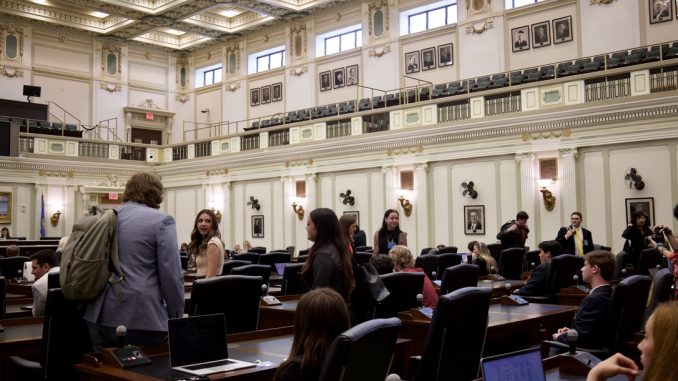
Today, as we, the Oklahoma Intercollegiate Legislature, gathered for its 2nd Session of the 57th Oklahoma Intercollegiate Legislature, a moment was taken to acknowledge the state’s powerful legacy. Understanding what strength the state displayed in its past will give today’s legislators more insight into how they can succeed moving forward. Oklahoma was once known for its Black Wall Street, the state’s jazz tradition, and the development of Booker T. Washington High School. Heated highlighted that the school board aimed to make it “so good that everyone wants to come there.”
“Oklahoma was able to build and create all sorts of culture and buildings, and that optimism is ingrained into us,” Heaton said. When dust storms or tornadoes threaten communities, they do not pause to evaluate differences before extending help to one another. This neighborliness offers a useful parallel for the present. Likewise, the “storms” of today’s political landscape require the same instinct to band together. In fact, this has been the heart of political change: after all, differences are the way to achieve common ground in the benefit of all, not a perfect result. Instead, having a mixture of gold and emerald that, individually, are great but, together, are paramount. Provide a framework for how delegates might approach their work this week.
Cultural conflict, polarization, or competing priorities beg the same response. Despite those moments when using relationships for personal advancement may seem expedient, maintaining the values that shaped Oklahoma’s history best honors the moral example set by earlier generations.
As delegates navigate debate and disagreement this week, the keynote’s message offers a reminder that the state’s strongest tradition is not division, but the ability to weather storms by standing together. Thus, it is fitting that this dialogue is held beneath art that honors those who weathered the many storms before our time.