
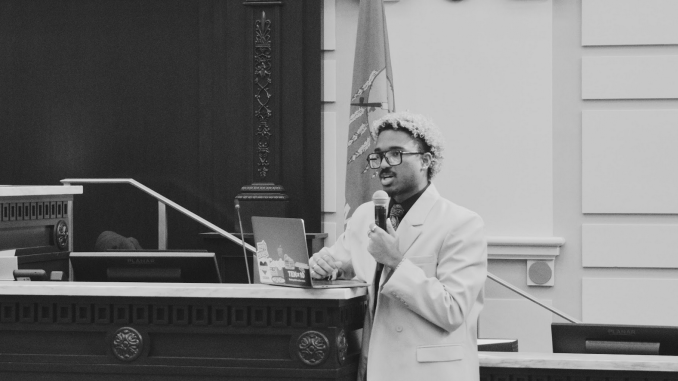
Journalist: Colin Udall. (OSU)
The “Fair Representation in Club Charters Requiring Youth Approval and Neutrality With
Accountability Limiting the Tyrannical Education of Regional Superintendents Act” of 2025
passed unanimously in the House of Representatives. In the Senate, the bill passed by a vote of
21-1. Representative Osei (ORU) introduced the legislation. The bill is amendatory, and it seeks
only to add one provision to the powers and limits of the state superintendent.
The bill reads: “The state superintendent of public instruction shall not establish, direct,
authorize or implement any student club, organization or chapter on the campus of a public
secondary school (grades nine through 12).”
In September 2025, State Superintendent Ryan Walters sought to incorporate a chapter of the
student organization Turning Point USA in every school across the state. Political rationale aside,
objections were made to the motion when Walters announced that districts could be in “danger”
if they went against it.
Rep. Osei said in an interview, “[The bill] is amending the statute, just about what the powers of
the Oklahoma state superintendent has.”
Further, Osei said, “I just felt the need to explicitly lay out in the power section of Oklahoma
statutes what the state superintendent can and cannot do. Specifically, what my bill is doing is
just saying that the state superintendent cannot enact clubs from the state down to the districts
because that would be big government overstepping little government.”
To clarify the intent, Osei was asked if this was primarily an issue of big and small government,
to which he said, “Yes.”
When asked about any objections to the bill, despite its success in both chambers, Osei said,
“The questions I was asked in the Senate were more about discussing grandfathering in existing
clubs. I do not think existing clubs are touched by this bill, because there are no existing clubs
that have been enacted by the superintendent. There should be no worry for existing clubs and
they should be able to do what they want.”
As is often seen in the Oklahoma Intercollegiate Legislature, the bill’s intent is more about the
logistics of government function rather than a reflection of party lines. The bill now moves to the
governor’s desk.