
Journalist: Heba Saleh (TU)
SB TU-002 would have eliminated the tax credit program for parents who send their children to private schools.
After having passed the Senate, the bill was presented to the House of Representatives. Soon after the author concluded his explanation of the legislation, members of the House brought up various concerns regarding the effect this would have on the families of low-income students attending private school — families who could not otherwise afford the cost of the school without the tax credit.
The proponency, however, believed in repealing the tax credit in order to divert the money to public schools. The bill, however, did not make mention of where the money that would have been a tax credit would go.
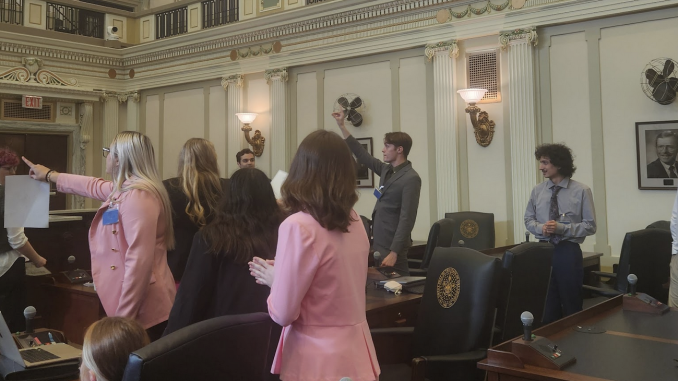
When time for debate came, the chamber called for it, making this legislation one of a handful of Senate bills to be called for debate in the House. Four individuals were on the opponency, against the bill, and two on the proponency, in favor of the bill, one being the author as he would not have had an author’s summation.
Representatives in debate brought up many arguments that were made on the floor. One was the aforementioned argument that this act bars low-income students from attending private schools. Another was, as they termed it, the assumption that all private school children are rich. In their view, this legislation would not act as intended as it would harm the lower and middle-class students by removing their ability to attend the school while doing nothing to affect the very wealthy who could afford the school regardless.
While caucusing, representatives also added that, in a state like Oklahoma that ranks near the bottom of the list in education consistently, the tax credit program is necessary to provide low-income students with the best education their parents could provide.
Proponents in debate focused on addressing the subject of using public funds for a tax credit. This was in response to members’ discussion in caucusing of the fact that parents of private school children are not utilizing what they paid for in taxes — public schools. Proponents made the argument that just because someone is not directly benefiting from a public service, they are not excused from paying for it. One debater cited the fact that she pays for Social Security and Medicaid when she pays taxes but does not receive benefits from them. They are a good for society as a whole, she argued, and should be funded.
Despite the efforts of the proponency, the bill ultimately failed 6-46.