
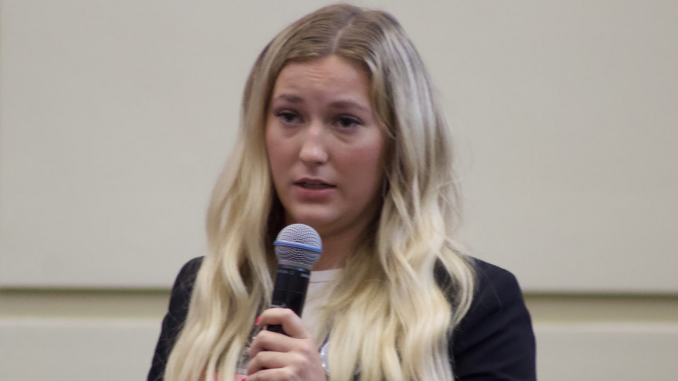
Journalist: Shelby Tannehill (OSU)
Oftentimes, the most interesting legislation are the ones you don’t expect. More often
than that, the most vital legislation has deep, personal ties to the author. Take Senate Bill SE-002,
or the “Veterans Prescription Access” Act of 2025. The bill, authored by Senator Charitie
Massengale, passed the senate this morning 22-0-7.
S.B. SE-002 would require all Oklahoma pharmacies to accept valid veteran’s insurance
as payment for prescription drugs and pharmaceutical services. If pharmacies refuse to comply,
the new law would result in warnings and fines of up to $25,000. As of this morning, an
amendment was also put in place to create the Veteran’s Access to Healthcare Compliance Fund.
The fund would be run by the Oklahoma Board of Pharmacy and provide funding for outreach,
assistance, and compliance monitoring.
“Extremely encouraged,” Sen. Massengale said when asked how she felt about her bill
passing the senate. “I’m glad to see that all of the active voters supported the bill and recognized
the barriers that veterans face to access medication they need and earned.” Sen. Massengale said
in the senate this morning that this bill was inspired by her own father, a U.S. Army veteran, and
his struggle to receive the proper medication in a moment of dire need after being bit by a spider.
He went to urgent care and was prescribed antibiotics, but none of the pharmacies nearby
accepted his VA insurance. “His only choice to get the medication was to drive to the nearest VA,
wait 3-5 days or pay hundreds out of pocket,” Sen. Massengale said. “That was just an
unacceptable reality for our veterans.”
S.B. SE-002 is now in line to go through the House of Representatives, and Sen.
Massengale is hopeful. “This policy is low-cost, high impact, and fundamentally about honoring
our obligation to veterans,” Sen. Massengale said. “I want to see the House move quickly and
send it to the Governor’s desk with strong support.” More than this, though, the senator hopes to
see a bill like this pass the true Oklahoma legislature in the near future. “Beyond the competition,
I hope that this bill can be passed into real legislation, if not I hope that something like it is
created in government and passed very soon.”